


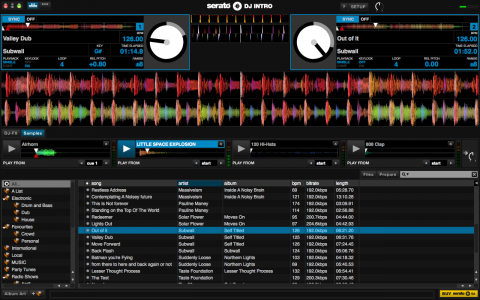
Serato sits in a rare category of music technology: it is both historically influential and still actively shaping modern DJ workflows. Its identity was built first through audio algorithms (Pitch ’n Time), then through the transition from analogue control to digital playback via DVS, followed by a long era of tightly integrated hardware-and-software performance systems.
A brief history (why the milestones matter)
Serato’s own timeline begins with Pitch ’n Time (1999), and quickly expands into NoiseMap control tone and Scratch Live (2004) with Rane a turning point that helped normalise timecode vinyl as a professional standard. The next big shifts include ITCH (January 2008), which supported a plug‑and‑play controller approach, Serato Video (2008), Serato DJ Intro (September 2011), and Serato DJ (2012), which unified the platform across the product range. In 2018, Serato rebranded its flagship products as Serato DJ Pro and Serato DJ Lite. Serato Studio arrived in June 2019, and in December 2022 Serato DJ Pro/Lite 3.0 introduced Stems as a performance-ready feature.
Most recently, Serato DJ Pro and Lite 4.0.0 (August 2025) delivered what Serato calls its most significant library upgrade in its history, rebuilding core organisation tools such as ratings, crate utilities, and streaming‑track handling.
Core features (what Serato does well)
Serato DJ Pro combines practical DJ fundamentals (beatgrids, hot cues, looping, analysis, flexible waveform views, sampler use, and multi‑deck performance on supported hardware) with advanced tools that are integral to how many working DJs perform:
- Stems: real‑time separation and performance controls (including stem‑based FX) are designed for transitions, mashups, and live edits. Importantly, Serato documents multiple ways to use Stems depending on hardware and mode.
- DVS: Serato DVS enables turntables or media players to control digital files via NoiseMap timecode, positioned as a low‑latency solution.
- Video and karaoke: Serato Video expands DJ Pro into video playback, transitions and effects, plus MP3+G karaoke support.
- Streaming: Serato DJ Pro supports major streaming providers (Apple Music, Beatport, Beatsource, SoundCloud, Spotify, and TIDAL), but each provider has its own limitations. Official FAQs make clear that some streaming tracks cannot be used with Stems or recording, and several require live internet connections.
Licensing and pricing (what you pay for)
Serato’s main DJ software offering is Serato DJ Pro, available via subscription or perpetual purchase. Serato DJ Suite bundles DJ Pro with key expansions such as DVS, Video, Flip, Play, Pitch ’n Time DJ, and Club Kit. Serato DJ Lite remains a free starting point, with a hardware-and-licensing model that determines what features are immediately available.
Hardware support (the Serato approach)
Serato is defined by “official hardware support.” The Serato DJ Hardware database is the source of truth: it lists compatible controllers, mixers, interfaces and accessories, and includes licensing category badges. Serato also documents the major licensing categories (Pro Hardware Unlocked, Lite Hardware Unlocked, and Paid Upgrade to Pro), plus a DVS licensing layer. This structure is central to how Serato maintains consistent performance across a wide range of equipment.
Mappings and customisation exist, but within Serato’s ecosystem rules. Official documentation explains how MIDI mapping can be used to remap supported primary hardware (where available), map secondary MIDI controllers, and save presets — while also noting clear limitations (for example, certain controls cannot be remapped).
Conclusion
Serato’s strength is not a single “killer feature.” It is the combination of a long engineering lineage, a hardware-first performance philosophy, and a modern feature stack that includes Stems, streaming, DVS, and video. The 4.0 library rebuild matters because it targets the part of DJing that quietly costs the most time: organising, preparing, and reliably finding the next track under pressure.