


Affordable standalone DJ hardware is an attractive idea. An affordable system that also gives developers room to build their own software is a more interesting proposition.
That is the direction behind Behringer’s latest preview: an early standalone DJ design carrying the ANIMA name, with a proposed price of US$300–$400 and an emphasis on open hardware. Resident Advisor reported the announcement on 28 October 2026. This is still a development preview, not a finished product with a confirmed launch date.[1]
The important question is not simply whether Behringer can make something cheaper. It is whether an open approach could give DJs a useful alternative without making them responsible for solving every technical problem themselves.
From an early prototype to a possible DJ platform
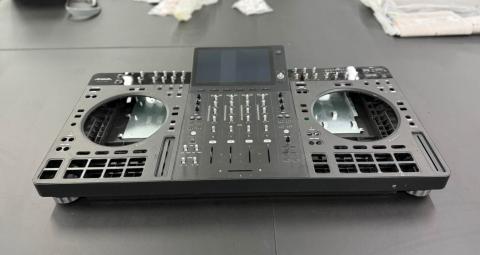
Digital DJ Tips describes a four-channel layout with a central screen, long pitch faders and spaces for performance pads. Its prototype photographs show an unfinished unit, with the jog wheels and pads not yet fitted. The publication identifies the design as the Klark Teknik Anima; Resident Advisor is more cautious about treating the model name as confirmed.[1][3]
That distinction matters. A photograph can show the intended control layout, but it cannot demonstrate how the controls feel, how quickly tracks load or how reliably the system behaves during a long set.
For now, the sensible approach is to discuss the design as a proposal. There is no basis here for a hands-on review, and we have not tested the hardware.
The open-hardware idea: freedom needs a usable workflow
Behringer’s announcement centres on hardware without proprietary lock-in and the possibility of users developing their own software. Resident Advisor describes this as the central difference from a conventional closed platform.[1]
In practical terms, our interest is in what that freedom could mean for everyday DJing:
- A setup that can develop around the DJ’s preferred workflow.
- Community experiments with different interfaces and performance tools.
- Clear documentation that makes modification realistic rather than theoretical.
- A dependable standard configuration for people who simply want to load music and mix.
These are possibilities and expectations, not announced features. Openness would be less useful if essential functions depended on finding an unofficial project, compiling code or troubleshooting an update immediately before a booking.
The strongest version of this idea would offer both routes: a stable starting point and room for technically confident users to experiment.
Standalone does not automatically mean software-compatible
For DJs considering a different platform, the music library should be one of the first things to investigate.
Our suggested compatibility checklist would include:
- Which file formats and storage devices are supported?
- Can existing playlists, hot cues and beatgrids be imported accurately?
- What happens when a track has not been analysed beforehand?
- Can the system perform a complete set without an internet connection?
- Is there a straightforward way to back up and restore the library?
Digital DJ Tips raises the unresolved question of what software the system will run and discusses Mixxx as a possible candidate—not as a confirmed implementation.[3] A familiar-looking console should not be treated as proof of support for an existing commercial DJ platform.
For a working DJ, keeping years of preparation intact may matter more than gaining another performance effect. Any future comparison should test that migration process, rather than judging the system from its front panel.
Why the proposed price deserves attention
The US$300–$400 figure is a proposed price from the announcement, not a verified UK retail price. Gearnews also reports that range while noting that availability remains unknown.[1][4]
Our view is that a lower entry price could make this kind of equipment interesting for home practice, teaching and experimentation. It could also encourage people to try a standalone workflow without immediately committing their main performance setup.
However, the purchase price is only one part of value. Before recommending it, we would want to understand software support, repair options, warranty arrangements and the cost of any additional equipment needed to make the advertised workflow practical.
An inexpensive unit that works reliably could be valuable. An inexpensive unit that demands constant attention would be a different proposition.
What would make it ready for a real set?
Our priorities for a future hands-on test would be deliberately practical:
- Stability: a long mixing session without freezes or unexpected audio interruptions.
- Responsiveness: consistent cueing, looping, browsing and loading.
- Sound and connections: suitable levels and dependable connections for the intended setup.
- Recovery: a clear procedure when a drive, update or software configuration causes a problem.
- Support: documentation and a maintained release that non-developers can use.
This is not a list of faults in the prototype. It is the standard we would apply before relying on an unfamiliar system in front of an audience.
Conclusion: a promising direction, not a buying recommendation yet
The appeal of ANIMA is the combination of an accessible proposed price and a more open approach to DJ hardware. The available reporting still leaves the final specification, software and delivery timetable unresolved.[1][3][4]
For DJ TOTY GEE, the interesting outcome would be a product that makes creative freedom easier to use—not one that exchanges a closed ecosystem for a different set of complications.
Until a finished unit can be tested, this is an announcement worth following rather than a reason to replace a working setup.
Sources and image credit
[1] Resident Advisor: Behringer teases open-source standalone DJ system, Benny Sun, 28 October 2026.
[3] Digital DJ Tips: Klark Teknik Anima preview, Phil Morse, updated 28 October 2026.
[4] Gearnews: Behringer ANIMA DJ Controller, Stefan Wyeth, 28 October 2026.
Featured image: Behringer prototype photograph, sourced via Digital DJ Tips. It shows an unfinished unit, not the publication’s AI-generated mock-up. Image reuse permission has not been independently confirmed; review before publication.