


The Music Industry Needs an XR Performance Licence Before Innovation Moves Elsewhere
Image
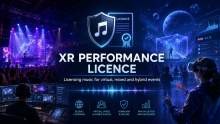
Virtual and mixed-reality music performances are no longer theoretical.
DJs can already learn on accurately modelled club equipment, perform in social VR spaces, stream sets to external audiences, and combine music with interactive visuals, avatars, and spatial environments. Platforms such as Tribe XR demonstrate that the technology is moving from experimentation towards a credible creative and educational ecosystem.
However, the UK’s music-licensing framework has not yet developed an equally clear route for the people creating these experiences.
PRS for Music, PPL and PPL PRS now have an opportunity to lead: create a transparent, accessible licence designed specifically for fully online XR performances and hybrid physical–virtual events.
Existing licences cover parts of the experience — but not the whole
The problem is not that music used in XR exists outside copyright. Rights still apply.
TheMusicLicence already covers the public performance of live and recorded music in many physical venues and events. PRS also provides different licensing routes for online services, streaming, mechanical uses and synchronisation. Official guidance recognises that businesses may require separate permission when using music online or through mobile technologies.
The difficulty is that an XR event may involve several uses at once:
a DJ performing to people inside a physical venue;
remote guests attending as avatars;
music transmitted live across international borders;
interactive and audio-reactive virtual environments;
commercial sponsorship or ticketing;
recordings, clips and on-demand replays;
music combined closely with persistent visual content;
audience and track-use data generated by the platform.
A physical public-performance licence may cover one part of that activity. A digital or communication-to-the-public licence may cover another. Recording, copying or synchronising music with visual material may introduce further permissions.
What is missing is a clear, recognisable route that tells an organiser:
“This is the licence you need for an XR music event, this is what it covers, this is what it costs, and this is how royalties will be reported.”
I could not identify a publicly advertised, standard UK licence that bundles these elements specifically for an XR nightclub, immersive DJ performance or mixed-reality music event. PRS has discussed the implications of virtual and augmented reality since at least 2017, and has previously cited licensed VR services such as MelodyVR. The conversation has therefore already begun; the next step should be a practical product for creators and organisers.
Why clarity matters: the Marc Kearns case
A recent copyright prosecution provides a useful reminder of why legitimate, understandable licensing routes matter.
Public reporting indicates that Marc Kearns, also reported as Mark in some secondary coverage, was sentenced at Hull Crown Court on 11 June 2026 after pleading guilty to multiple copyright offences connected with producing and selling unauthorised remix CDs.
Reports say he received a 26-month custodial sentence suspended for 18 months, was ordered to complete 250 hours of unpaid work, and was required to pay more than £21,000. The most detailed account identifies this as £21,885 in prosecution costs. A financial analysis reportedly estimated approximately £220,979 in sales receipts.
That case concerned the commercial manufacture and sale of infringing physical products. It is not legally equivalent to a licensed DJ performance in XR, and it should not be presented as though every remix or online set creates the same criminal liability.
Nevertheless, it illustrates an important principle: creative technology does not remove the need for permission when protected recordings and compositions are commercially reproduced, distributed or exploited.
The lesson should not simply be “do not innovate”. It should be:
Make legal innovation easier than infringement.
Creators need to understand where performance ends, and reproduction, adaptation, synchronisation or commercial distribution begins. Rights holders need accurate reporting and fair payment. Platforms and promoters need a licence they can actually identify and purchase.
The opportunity for PRS and PPL
An XR licence should not replace existing music rights. It should package them more clearly for a new kind of event.
A practical framework could offer two main options.
1. Fully virtual XR performance
This could cover a live music or DJ event delivered entirely through a virtual platform, with no audience physically present at the performance location.
The tariff could consider:
ticket revenue or subscriptions;
sponsorship and advertising;
audience size;
UK-only or international availability;
live-only access or a limited replay window;
commercial versus educational or community use.
2. Hybrid physical and XR performance
This would cover an event with both an audience inside a licensed venue and remote participants entering through VR, desktop or mobile platforms.
The licence could serve as an XR extension to TheMusicLicence, rather than forcing organisers to obtain several unrelated permissions separately.
Optional additions could address:
on-demand recordings;
promotional clips;
branded immersive environments;
closer synchronisation of music and pre-produced visuals;
user-generated recordings;
multi-territory access.
Not every right can necessarily be cleared through one collective licence, particularly where direct permission from record labels, publishers or other rights owners is required. A useful XR framework should make those exclusions explicit instead of leaving organisers to discover them after an event has been designed.
Better reporting could benefit rights holders
XR platforms are digital by nature. Unlike many physical events, they can potentially generate accurate information about:
which tracks were played;
how long they were used;
how many people attended;
where audiences joined from;
whether the event was live or replayed;
ticket and subscription income;
levels of audience interaction.
This creates an opportunity for more accurate royalty distribution.
Rather than relying only on estimated attendance or manually submitted set lists, PRS and PPL could establish a standard reporting format or application programming interface for XR platforms. Platforms such as Tribe XR and future virtual venues could then provide structured usage data subject to suitable privacy protections.
The result could be a system that is not only simpler for organisers, but also more transparent for songwriters, composers, performers, labels and publishers.
Start with a pilot, not a perfect universal solution
The industry does not need to solve every possible metaverse use before acting.
PRS, PPL and PPL PRS could begin with a voluntary pilot involving:
one or two XR music platforms;
independent DJs and promoters;
rights-holder representatives;
educational providers;
a small number of hybrid venues;
technology and accessibility specialists.
The pilot could test a simplified tariff for limited live events, with clear attendance, revenue and track-reporting requirements.
It should also recognise that XR has potential beyond commercial nightlife. Immersive performance can improve access for people who cannot easily enter conventional venues because of disability, geography, caring responsibilities, cost or anxiety. A proportionate community or educational tariff could encourage responsible experimentation without imposing the same cost structure as a major commercial festival.
Why action is needed now
Virtual nightlife is unlikely to replace physical clubs completely. The more realistic future is a combination:
conventional venues enhanced by XR layers;
remote guests participating alongside physical audiences;
fully virtual performances for global communities;
educational rehearsals becoming public showcases;
DJs working increasingly as performers, broadcasters and immersive-experience designers.
Technology companies are already building these environments. DJs and audiences are already experimenting inside them. If licensing remains fragmented, innovation may move towards closed catalogues, royalty-free music, direct deals available only to large platforms, or jurisdictions that provide clearer frameworks.
That would be a missed opportunity for the UK music industry.
PRS and PPL have historically adapted to new formats, from broadcasting and online streaming to contemporary public-performance licensing. An XR performance licence would be a continuation of that role—not a departure from it.
Conclusion: licence the future rather than leaving it in a grey area
The purpose of a new XR licence should not be to weaken copyright protection. It should do the opposite.
It should give creators a practical legal route, give rights holders clearer reporting and revenue, and give platforms confidence to invest in legitimate immersive music experiences.
The Marc Kearns case shows the consequences of commercially exploiting protected music without the necessary permissions. The growth of Tribe XR and other immersive platforms shows where music performance may be heading next.
Between enforcement and innovation, there must be a clear licensing bridge.
PRS for Music, PPL and PPL PRS are in the strongest position to build it.
Proposed name
The XR Music Performance Licence
Covering:
fully virtual live music and DJ performances;
hybrid physical and XR events;
optional recording and replay rights;
clear guidance on synchronisation and excluded rights;
platform-based track, attendance and revenue reporting.
The technology is here. The audiences are forming. The creative community is ready.
Now the licensing framework needs to catch up.
Published on
-- Category --:
Articles
-- Tags --:
XR music licensing -
PRS for Music -
PPL -
PPL PRS -
TheMusicLicence -
virtual reality -
mixed reality -
Virtual Nightlife -
DJ copyright -
Immersive Events -
Tribe XR -
music royalties -
digital performance -
Hybrid Events -
music innovation